 My Patrix site
Is Apple an Enterprise Gatekeeper?
Asked by David Emery
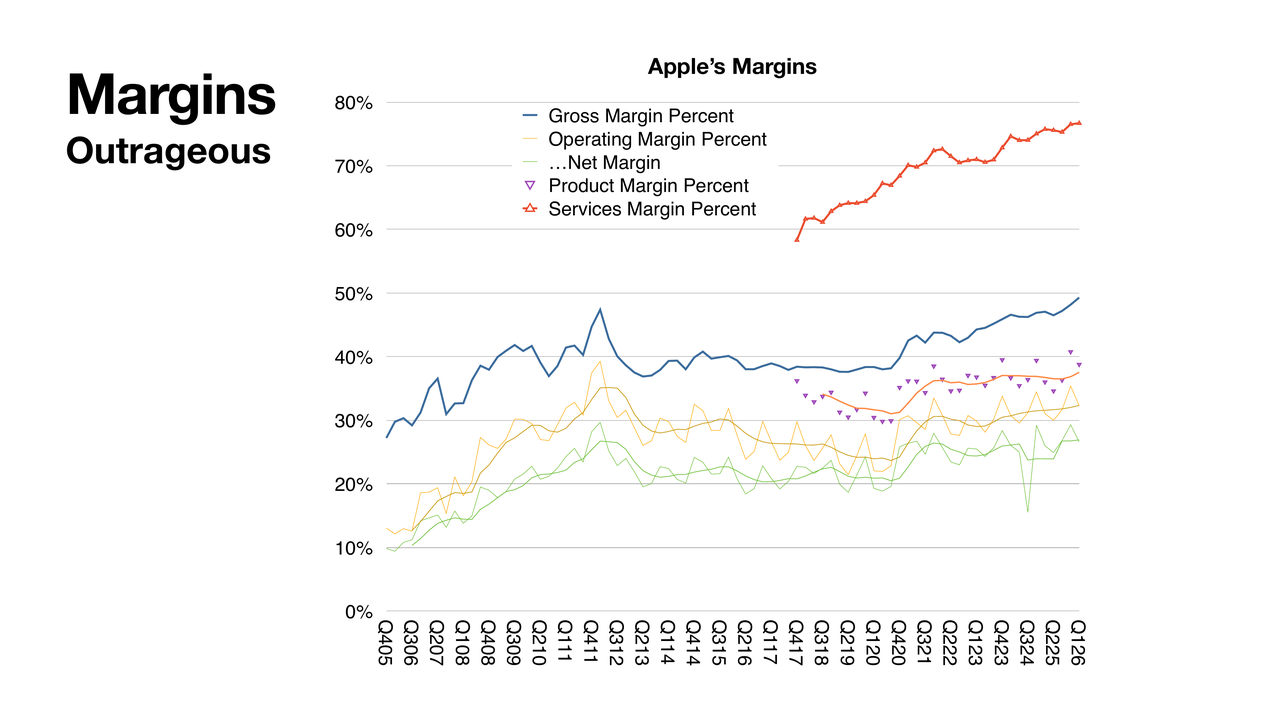
Q: What’s the potential legal regulatory risk to the Apple enterprise combining both products and services? You can make a case that services growth over top of the monopoly in hardware is an illegal monopoly. That seems to be the way regulators are going. And forcing a split between services and products could definitely damage Apple as a whole.
Sure. So let me take a European — not just point of view, but sort of a language. The language is that of being a gatekeeper, and a gatekeeper has a responsibility not to exclude competitors, because if you’re big enough as a gatekeeper, you effectively are a platform for millions and millions. And so it matters how many. It’s not just a gatekeeper per se, but a gatekeeper with a sufficient audience. And the logic there is that you can’t bundle your own services and therefore exclude — especially by putting yours as a default, then the others have a hard time competing.
And that is an antitrust logic. May or may not agree with it. I certainly don’t, but I’d say it’s a clear argument when seen through this gatekeeping phrase.
Now, the difference — what you’re asking is in business. Well, that doesn’t fall under the same restriction. Usually, because antitrust is about consumer protections. There’s a lot of businesses which get into complex deals that are tolerated because it doesn’t affect the mass population. Now, of course, collusion and other things are still illegal. But I think you get a little bit more of a pass if you’re solving the problem for businesses. There’s one reason why Microsoft got away with what they were doing for so many decades. It’s only when, in the late 90s, consumer personal computing became so prominent that there arose an antitrust argument about bundling everything into the operating system that got them into trouble.
So I think Apple’s bundling hardware and services for business users is probably going to be okay for a while. I would just say it’s a question of quantity rather than the logic at this moment, so I wouldn’t worry about it yet.
But there are ways around it. Even if you do want to worry about it, there are ways around it which basically deal with providing provisions for alternatives, and that’s what Apple’s done to comply over and over again. Bending over backwards, providing alternatives, providing options. But then nobody uses those options, because they’re far more complicated.
The law is futile on this, because it doesn’t take into consideration user satisfaction. It doesn’t take into consideration the ease of things as opposed to the existence of things. It’s nice to have options, but if it’s complicated and annoying and expensive, you don’t use the options. And so they have a very crude mechanism to try to enforce some utopian view of economic benefit. It just tends to create unnecessary penalties for consumers and producers, and as a result, they’re just tripping over themselves. It just leads to all kinds of dysfunction.
Quality is what Apple’s always said — quality, experience, ease of use. And bureaucracies are not oriented around either quality, efficiency, or delighting anything. It’s incompatible with all of the work people do at Apple. And so it ends up being a net negative, overall, in my opinion.
This was one of the questions asked by the participants in Asymco’s May 2026 Office Hours live Q&A sessions, open to Asymco One subscribers.
See also: May 2026 Office Hours
Comments