 My Patrix site
Is the Market Overvalued? Four Perspectives
Data, data everywhere but not a conclusion in sight.
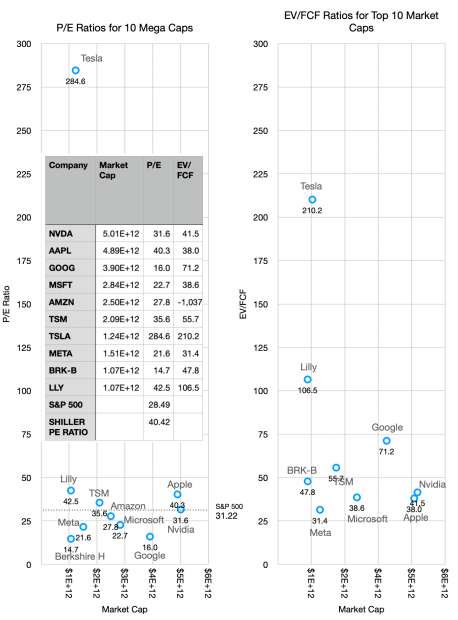
Is the market overvalued? Two measures to consider are P/E and EV/FCF. Here are those measures for 10 of the largest companies in terms of market capitalization and the overall S&P 500. Note: Amazon EV/FCF is less than negative 1,000 and is therefore excluded from the second graph. As we move forward the FCF for more of these companies will turn negative. Alphabet just recorded its first negative cash flow since going public in 2004.
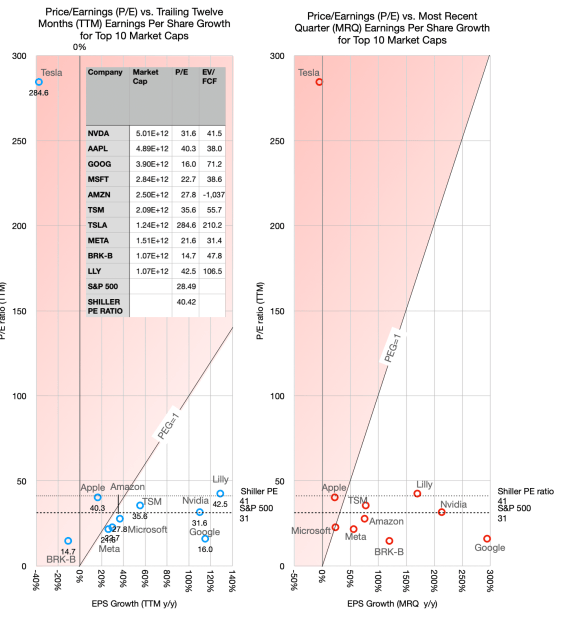
P/E should be compared to growth rates. Both growth in the most recent quarter and in the last 12 months. Here are those P/E vs. Growth measures for 10 of the largest companies in terms of market capitalization and the overall S&P 500. Rule of thumb: if PE=Growth*10 (PEG=1) then the company is “fairly valued”. But, given crazy capex, we should also look at EV/FCF…
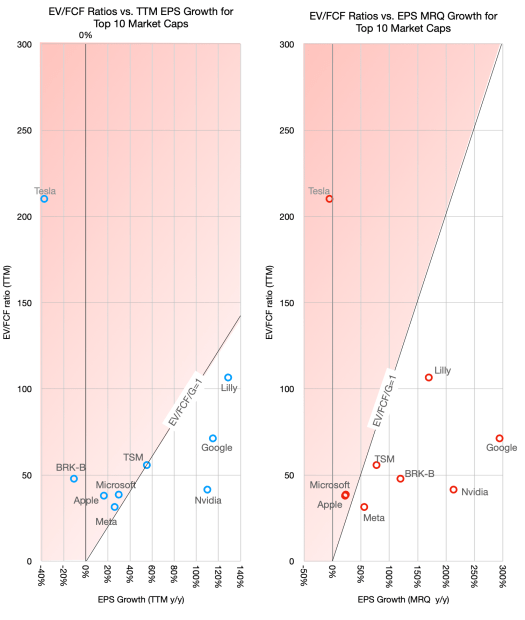
In addition to P/E, Enterprise Value/Free Cash Flow should be compared to growth rates. Both growth in the most recent quarter and in the last 12 months. Here are those EV/FCF vs. Growth measures for 10 of the largest companies in terms of market capitalization and the overall S&P 500. Rule of thumb: if EV/FCF=Growth*10 then the company is “fairly valued”. Note outlier Amazon is excluded due to negative FCF. Soon, it won’t be the only one. What other anomalies exist?
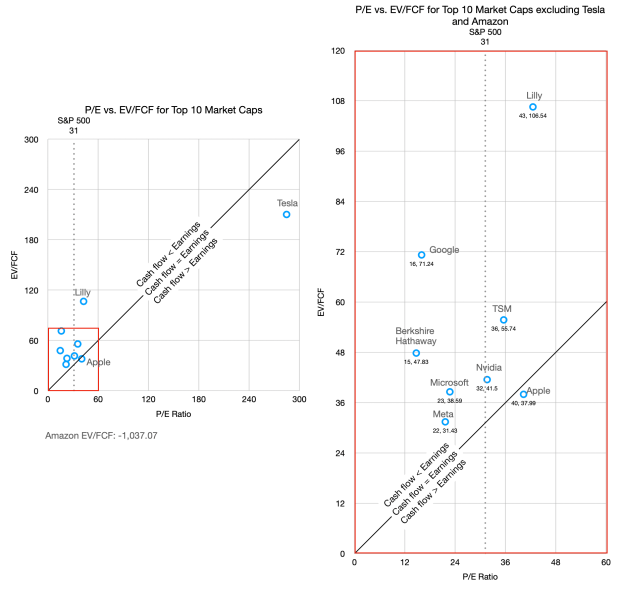
If the Price/Earnings (P/E) is similar to the Enterprise Value/Free Cash Flow (EV/FCF) then the company is “in balance” where neither cash is being used for investment nor earnings are overstated. Here are the two ratios relative to each other for 10 of the largest companies in terms of market capitalization and the S&P 500. We can see that the balance is uncommon. Apple is rather alone in that regard (apart from Tesla which is in its own bizarro world.) Amazon also is off the scale. Soon, it won’t be the only one.
So, is the market overvalued?
The rest of this post is for Asymco members. Continue reading on asymco.com.
Comments