 My Patrix site
Deploying Enterprise AI on Apple Hardware is Suddenly a no-Brainer
Apple’s AI angle in the enterprise
There was a time when Apple’s point to the Enterprise buyer was that Apple products were ultimately more cost effective and productive. The total cost of ownership was lower as the products were cheaper to maintain and lasted longer and users were more productive as the user experience frictions were lower than Windows.
The problem was that Apple devices were at odds with IT policies and standards. Everything from device management, software licensing, identity and authentication management, migration, training, security were built excluding the Apple platforms. The Microsoft world was interlocking and impenetrable even if it was sub-optimal on metrics of performance.
It began to change with the subversive iPhone and iPad. As not only some early adopter employees but management itself began to bring their personal devices to work and ask IT to make the “systems” work through them. Thus the infiltration was not as much through the “grass roots” but through the top of the food chain. The canonical example was the CEO demanding to use an iPad to speed run meetings all day.
And from that crack Apple penetrated enterprises to such an extent that today the MacBook Air is the world’s best selling enterprise laptop. The iPhone and iPad are also the best selling enterprise phones and tablets. More Apple devices are purchased in enterprise than any other brand.
Though MacOS and iOS are still not the majority platforms, in some verticals such as surgery, Apple Vision Pro has been established as the only viable option.
But now that AI is becoming a new wave of software/service for Enterprises, Apple is surprisingly in the driver’s seat for being the best platform for deployment.
By “best” I mean objectively best in performance, security and, most shockingly, cost.
Best Performance
Though there are lower cost alternatives, the top of the line Mac Studio in a cluster configuration can provide 2TB of unified memory, 1.2 TB/s of bandwidth and handle up to to 1.6 trillion active parameters.
It’s hard to visualize these numbers but what it boils down to is that enterprises can deploy vast models to run locally. Why locally? Because many examples from healthcare to aviation to transportation to financial services require privacy, off-line or compliance which disallow cloud-based services.
By one estimate, 50% of Enterprise AI inference will be processed locally by 2030. Half of the market for enterprise AI will be on device. This is profound.
Best Security
Apple offers built-in security at every layer: Service layer, Network, App, Data, System, and Silicon hardware. This is religion for Apple and not an after-thought. As such, the frameworks were ready before even the new AI as a service has been invented.
Best Price
This is the most surprising and most consequential development.
Apple devices already have the higher residual value, highest employee affinity, lowest operating cost (due to security mainly), lower energy cost and lower support cost.
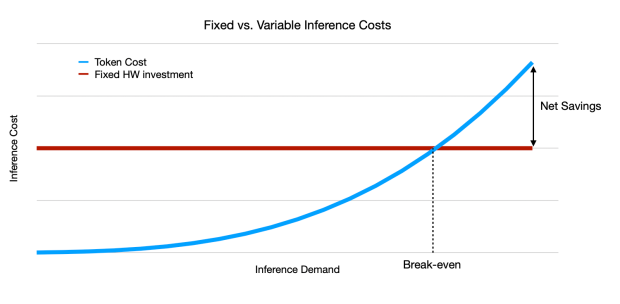
But now, when running AI, localized inference delivers a capped cost structure vs. an unlimited risk for token costs. The math is shocking.
Two examples:
- A 26B parameter business analysis model running for 4 hours a day consuming 150 million tokens a month results in a cost of between $450 and $850 per user per month. The alternative is to buy a MacBook Pro and run that same model at zero cost. The acquisition cost of a 16″ M5 Max with 40-core GPU and 128GB of unified memory is $6500. The payback period is 7 to 14 months. Thereafter the savings are $5400 to $10,200 per year.
- Agentic coding using an 80B parameter model running 12 hours a day and consuming 300 million tokens a month will cost between $900 and $1500 per user per month. The alternative is to buy a Mac Studio M5 Ultra 80-core GPU and 256GB 4TB storage for $11,219. The payback period is 7 to 12 months, saving $11,000 to $18,000 every year thereafter.
The graph at the top of this post illustrates that this net savings is available above a certain threshold. These are serious numbers when the number of possible users is in the hundreds. The fixed hardware investment is a significant game changer in AI implementations.
The questions changes from why should we use Apple devices to why shouldn’t we?
The rest of this post is for Asymco members. Continue reading on asymco.com.
Comments