 My Patrix site
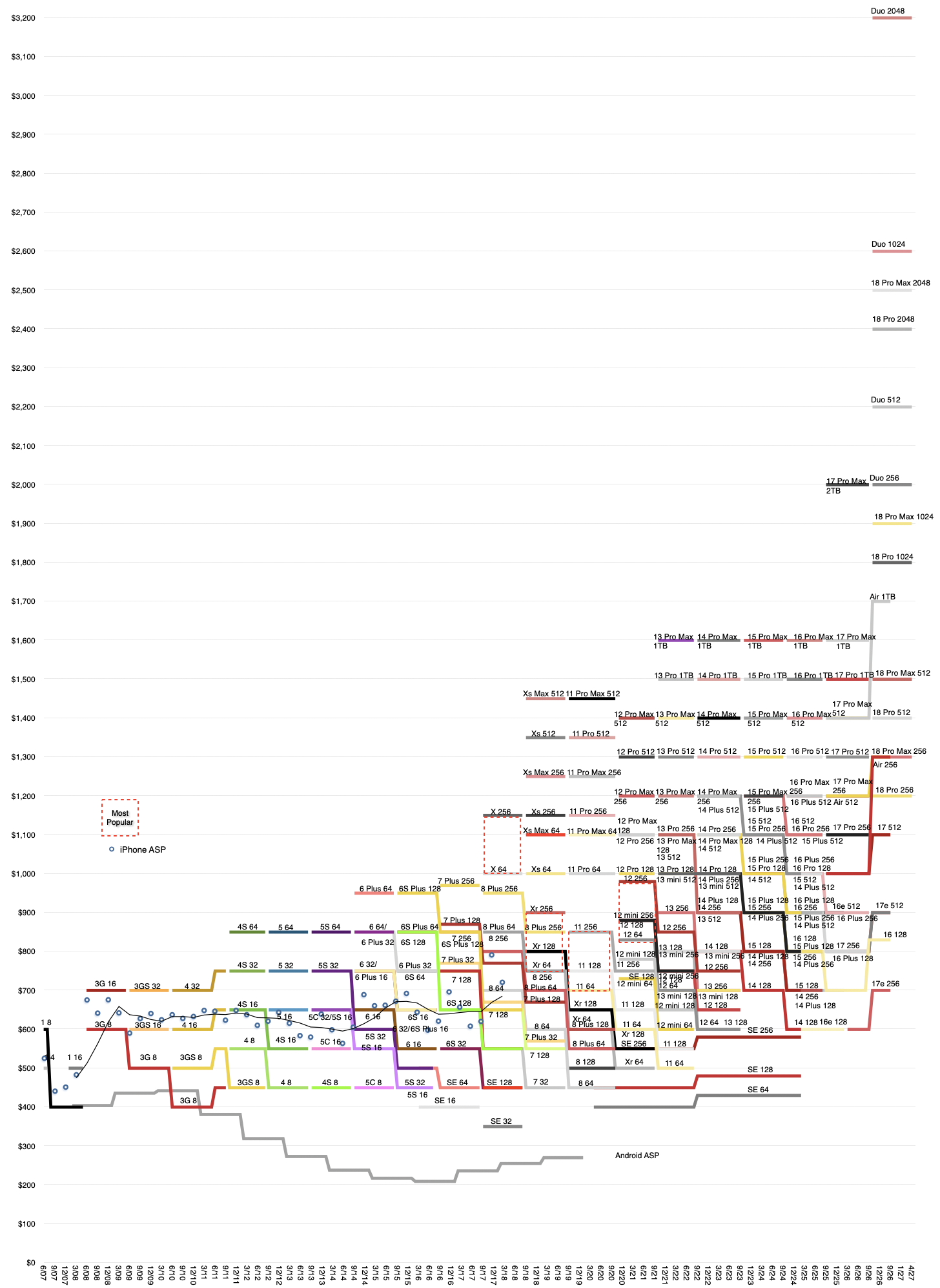
Stairway to the $3200 Heaven
An Office Hours question, September 11, 2026.
Q: The Stairway to Heaven now tops out at $3,200. That’s a very high price at presumably low volume. How does it affect your thinking about the average selling price?
If you look at the price increases as a percentage from the previous generation, there’s a range. They’re not the same. Obviously, if you’re going from 256 gigabytes to 512, that’s double, 1024 is quadruple, and then eight times, so you should see bigger jumps. Indeed, if you divide by the capacity, there’s some consistency, between 20 and 30 cents per gigabyte of additional cost. But some configurations are getting a kind of bonus, in the sense that their increases are lower, as low as 8%. That configuration is the 512 gigabyte, and the reason it got a break is probably because it’s the most common one. So there’s a higher increase at 256, it dips at 512, and then it comes back and is highest at 2048.
My expectation is that the sweet spot is the 512, and if I were to weight the pricing, I would concentrate on that price point as the mode, the most common configuration. It’s multiplying way too many assumptions to come up with an exact ASP, but I penciled in an average price increase of around 12%, which is way lower than most people thought. My estimate was 10 to 15, and we came in close to the 10. That’s a surprise.
What this does to the ASP depends on what the previous ASP was, and that is never given by Apple. People are saying it’s already at 1,200, or 1,100. I’ve been much more conservative. I thought it was about 900, and therefore now we’re at a thousand, perhaps. The reason I believe it’s lower than what the mainstream is saying is that I can’t reconcile the fact that there are 1.2 billion iPhones in use and only 200 million are sold a year. If only 200 million are sold a year, and some are to new customers, how do you account for, say, 150 million phones replacing the worn out, broken and obsolete portion of the 1.2 billion? It suggests the lifespan of the product is eight to ten years. That doesn’t make sense either, and no one is talking about this. The ASP immediately affects it: if you assume a huge ASP, you’re shrinking the volume, which means you’re not servicing the installed base.
There are several reasons the ASP is lower than list. When Apple publishes a price, there are retail margins. If they sell direct they get the full price, but through carriers you see the discounts popping up, and some of that is eaten by the distributor. Apple’s not getting full MSRP on every deal. And they account for the revenue differently: for compliance with GAAP they cannot book the hardware revenue if software is yet to be delivered, so some is deferred. Over time that evens out, but it distorts the picture.
Why are analysts fixated on the top? Because if you read the Stairway to Heaven, you fixate on the top. Oh, the phones are so expensive. But do you know how few two-terabyte units are sold? You need to be a YouTuber capturing video for hours to need a two-terabyte phone, or so wealthy that you don’t question it. That’s a vanishingly small number. What people forget is that there’s a lot of middle to low end. I was surprised, doing my inventory for the Stairway data, that the 16 is still available for sale, even lower than the 17e, which is considered the low end. There are a lot of good-enough phones down there. So what is the ASP? Excluding the Duo, I think it’s gone up to probably 1,100. With the Duo, we’re at 1,200. It all depends on how many Duos they sell. And a footnote: Duo sales start in October, so it’s not going to make this quarter at all.
One of the questions asked in Asymco Office Hours. The full recording and transcript are available to Asymco One subscribers.
See the proceedings at asymco.com/live.
Comments