 My Patrix site
Why do phones have cameras?
Or, why do cameras have phones?

In a retrospective on the iPhone Uno, I noted that the iPhone was launched with three “tentpoles:” a widescreen iPod, a Phone and an Internet Communicator. Effectively, a music player, telephone, and browser. All in one device. This positioning in 2007 bundled what were considered to be individual products: an iPod, a Phone and a laptop. By bundling these, value would be created in not having to select which you would take with you at any given time. You would have all three with you always.
I then noted that none of these tentpoles were the most popular uses for the product today.
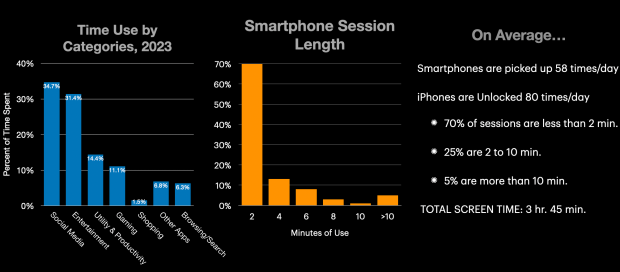
Social media and entertainment are by far the most popular, followed by utiliy/productivity and finally gaming to round out the top four uses. You can check your own usage patterns using the Settings app on your iPhone.
By checking Pickups you can also see the time division of usage. On average, smartphones are used in a log-normal distribution with the most common time being less than 2 minutes. The number of pick-ups and their distributions add up to almost four hours of use per day.
Based on this analysis, it would seem that the iPhone developed in ways unforeseen by its creators. Most of these activities did not exist on phones at all. There were games and there were messages and perhaps a bit of email but phones were mostly used for phone calls. Today, phone use does not usually show up in the top 10 activities.
The lesson is that truly transformative products create their own demand and their own use cases. You must be humble in your assumption of how buyers will use the product and also provide a platform for new use cases to be created by third parties. Apple did not create social media apps or games or YouTube for the iPhone. It enabled them.
But one thing missing from this analysis is the camera. Whereas Apple invested in development of a better screen and processor and storage and services to support the apps to became the “killer” apps, it disproportionately invested in the camera.
Consider the latest iPhone 18 Pro. The cameras are the most prominent design element, shown in all photos of the product. The obverse of the camera view has no distinguishing feature. Cameras are featured as the primary differentiation of the product in advertising. “The ultimate performance and camera of any iPhone.” The tentpoles of the iPhone 18 Pro are: 48MP, variable aperture, f 1.48 lenses. The copy reads: “48MP Fusion Main camera with variable aperture. Improved low-light photos and video. Impressive depth of field.”
The latest cameras on the iPhone make it beyond good enough for professional use. It is very capable as the only camera a video or still photographer would need to earn a living. For the consumer it seems to over-serve by a mile.
But the camera is not what appears in the usage logs and is in a different world from the original tentpoles.
So why does the iPhone have a pro camera? Why is photography even something to consider in a phone.
When we look back, the idea of a phone with a camera was only put on the market in 19991. First seen in Japan, it was popularized by Nokia and by the time the iPhone launched it was already considered normal to have camera in a phone. It was no longer a “camera phone” but just a phone.
By 2007 disruption of traditional cameras was already underway. Digital photography moved quickly to displace analog or film photography. Point-and-shoot cameras quickly overtook every category and DSLRs had been booming. However, phones with cameras quickly overtook all others and the number of photos taken by them exploded by multiple orders of magnitude. Use in messaging, cloud storage and then social media itself came to embody photography.
New social media emerged around photos: Snapchat, TikTok, YouTube and Instagram were image-first social media while Facebook came to embody it. Now it’s hard to see any social media content which is text only.
In that way, the social media category became an “imaging” category. The camera’s improvements were social media improvements.
Today’s pro cameras are used to allow amateurs to appear pro in their posts. The value is in allowing a billion people to become both models and fashion photographers. Vanity is a bigger business than productivity.
But throughout this period Apple was not valued for being a vanity enabler. Its products and users were measured with dollars and gigabytes. Even today there is no “vanity market share” for iOS or Android. The contrast between what we measure and what people buy could not be greater.
It behooves the investor to understand this.
The rest of this post is for Asymco members. Continue reading on asymco.com.
Comments